Fraternal Birth Order Effect
I came across a video on social media about the fraternal birth order effect (FBOE) – something I found both curious and mildly frustrating. In this post, I'm going to unpack what it is and why it matters. I'll also share my own take on it.
What It Is
The fraternal birth order effect (FBOE) is an observation that the probability a man will be gay increases with each older biological brother he has from the same mother. The statistical odds increase about 33% with each older brother, so it looks something like this:
- Baseline chance for any man to be gay: roughly 2%.
- One older brother: ~2.6%.
- Two: ~3.5%.
- Three: ~4.6%.
- And so on.
It doesn’t apply to older sisters, step-brothers, adopted brothers, or non-biological brothers raised together. It only applies to biological older brothers carried by the same mother — even if they were raised apart.
The pattern was identified by Ray Blanchard and Anthony Bogaert in the 1990s and only reliably appears in men. The findings seem to hold up in meta-analyses and across cultures¹; it has been described as 'the most consistent biodemographic correlate of sexual orientation in men.'² Here's the clip:
For every older brother a male has from the same mother his probability of being gay increases. This is thought to be due to a trace in their moms immune system that governs hormone effects on the brain. But note: it’s a reflection of more not less testosterone exposure in utero. pic.twitter.com/itWCnWq66M
— Andrew D. Huberman, Ph.D. (@hubermanlab) March 30, 2026
Sourced from @hubermanlab discussing fraternal birth order effect; Accessed 3/30/26
But what does that mean for us?
Why It Matters
There are a few ways to interpret this observation³: one is that older brothers increase the odds of being gay in later-born males; another is that gay men tend to have more older brothers than do straight men.
But what explains the fraternal birth order effect? Why is this a pattern we observe? What is the underlying mechanism?
The leading mainstream explanation is this: that a mother's immune system develops antibodies against certain male-specific proteins produced by her male fetuses. This immune response becomes stronger with each successive boy she carries. These antibodies can then cross the placenta and subtly influence brain development related to sexual orientation in later-born sons, increasing their likelihood of being gay — it's known as the maternal immune hypothesis (MIH)⁴. And in my research, I found no other scientific theories that offer an alternative explanation to the fraternal birth order effect. But it's not the whole story.
Roughly 15% (about 1 in 7) of gay men are estimated to owe their sexual orientation to this fraternal birth order effect⁵. This means that for the large majority (~85%) of gay men, the number of older brothers they have played no causal role. In other words, one might be predisposed to homosexuality even if they had no older brothers at all – as is the case with me. This suggests that orientation is influenced and/or attributable to other factors besides fraternal birth order.
But what other factors?
My Thoughts
I mentioned I'm both curious and mildly frustrated by the chatter on social media about the fraternal birth order effect.
I'm curious because it's a pattern I've also noticed in others. Friends who have older brothers who ended up gay. It's not the observation I take issue with, it's the explanations that I find to be lacking.
The maternal immune hypothesis points to prenatal biology as a determining factor. Often it's presented as fact, not theory which leaves me feeling mildly frustrated. But what bothers me most is that something that started as an observation, quickly morphs into the 'born this way' narrative.
The maternal immune hypothesis certainly points to prenatal biology as a determining factor influencing one's orientation. It supports the idea that same-sex attraction is fixed, prenatal, and unchangeable. That narrative has dominated the conversation for decades, and it leaves a lot of men feeling there’s no path forward. Myself included.
It's clear that FBOE points to a pattern – one that many are quick to ascribe to deterministic and biological factors. But what if that pattern is actually pointing to a common family dynamic?
Here's an alternative explanation.
Younger brothers often grow up feeling overshadowed, left out, or fundamentally different from their older brothers. Older brothers are typically bigger, stronger, more confident, and more socially dominant — especially during boyhood. A younger brother can easily end up teased or bullied by the older ones. They might be excluded from games. Often they're playing catch-up, never quite feeling they measure up.
The fraternal birth order effect we observe could just as easily be capturing a relational wound that forms early and gets reinforced through years of family life. It seems to fit the personal stories so many men with same-sex attraction tell: that sense of having always felt different, never quite part of the masculine world. But is that a product of their prenatal biology or a symptom of the environment they grew up in?
Research also supports this idea. Psychologists have documented patterns in birth order psychology and sibling relationships. In families with multiple boys, sibling rivalry and power imbalances are common: older brothers frequently hold more physical and social power, leading to teasing, exclusion, or a constant sense of falling short⁶.
It's not that much of a stretch to say that these repeated experiences can create deep attachment wounds and a defensive detachment⁷ from other males, which some clinicians observe can later become sexualized as a way to repair the original longing for masculine connection and belonging⁸.
Proponents of the MIH would likely argue that the fraternal birth order effect holds even if brothers are not raised together, which they might say rules out postnatal 'nurture' explanations like family dynamics⁹. But we could also see that bit of data in a different light. That biological brothers are raised apart would indicate to me a less-than-ideal family environment. A separation, divorce or remarriage could also impact one's identity, leaving unhealed emotional wounds — especially if a young boy grows up with a father who is absent, distant, or inconsistent.
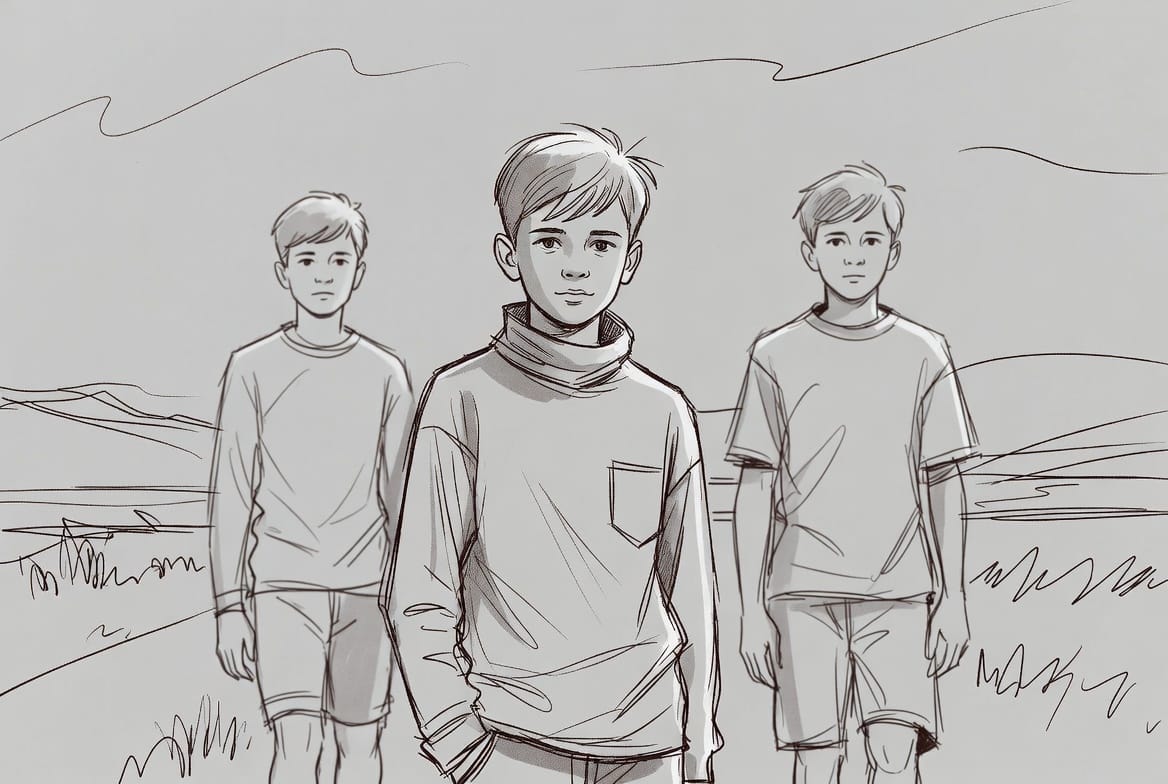
In offering this alternative, I'm not trying to ignore what the research tells us. I'm merely saying that prenatal biology cannot be the only factor. Because if everything is determined at birth, then what influence do I have over my own life? It's not a viewpoint I can accept.
And in some ways, it's less important whether you have older brothers or not. Even if the cards are stacked against you – doesn't mean you can't play a winning hand. Doesn't mean you have to fold.
I don't have all the answers and this is a complex topic. I'm curious to hear from you. What're your thoughts on all this? Consider leaving a comment below.
1) Blanchard, R. (2018). Fraternal birth order, family size, and male homosexuality: Meta-analysis of studies spanning 25 years. Archives of Sexual Behavior, 47(1), 1–15. https://doi.org/10.1007/s10508-017-1007-4
2) Bogaert, A. F. (2006). Biological versus nonbiological older brothers and men’s sexual orientation. Proceedings of the National Academy of Sciences, 103(28), 10771–10774. https://doi.org/10.1073/pnas.0511152103
3) Blanchard, R. (2014). Detecting and correcting for family size differences in the study of sexual orientation and fraternal birth order. Archives of Sexual Behavior, 43(5), 845–852. https://doi.org/10.1007/s10508-013-0245-3
4) Bogaert, A. F., & Skorska, M. (2011). Sexual orientation, fraternal birth order, and the maternal immune hypothesis: A review. Frontiers in Neuroendocrinology, 32(2), 247–254. https://doi.org/10.1016/j.yfrne.2011.02.004
5) Cantor, J. M., Blanchard, R., Paterson, A. D., & Bogaert, A. F. (2002). How many gay men owe their sexual orientation to fraternal birth order? Archives of Sexual Behavior, 31(5), 405–414. https://doi.org/10.1023/A:1014031201935
6) Whiteman, S. D., McHale, S. M., & Soli, A. (2011). Theoretical perspectives on sibling relationships. Journal of Family Theory & Review, 3(2), 124–139. https://doi.org/10.1111/j.1756-2589.2011.00087.x
7) Moberly, E. R. (1983). Homosexuality: A new Christian ethic. James Clarke.
8) Nicolosi, J. (2009). Shame and attachment loss: The practical work of reparative therapy. InterVarsity Press
9) The study has its limits. It drew on a total sample of 944 men across four groups, relied on self-reported family histories and sexual orientation, and was not longitudinal. These are common challenges in this area of research. But it leaves room to question whether the data can fully rule out postnatal influences (early family experiences, adverse childhood experiences and relational wounds).
Member discussion