Practical Tools to Reduce Unwanted Same-Sex Attraction, Pt. 2
Last week I wrote a piece on tools to reduce unwanted same-sex attraction. Those include a mindset shift, being aware of your emotional and physical state, managing thoughts, and improving relationships. They're all good things I try to do. For the most part, they've helped me on my journey.
But after I reread the post, I felt like what I wrote sounded more like general advice than practical tips. So for today, I want to amend that. I want to elaborate on the how. How to shift your mindset. How to manage your thoughts. How to improve your relationships.
So here are a few more tips. Hopefully they're a bit more concrete.
Notice Similarities, Not Differences
When I'm feeling down – when I'm in the 'grey zone' – that's when the same-sex attraction and behavior flares up. In the past, it's been a more chronic state, making me susceptible to triggers of sorts.
For example, if I'm already feeling down, but see an attractive guy – that would immediately set me down a path of fantasy, feelings and acting out. But now, when that happens, I try to do something different.
I try to notice the similarities, not the differences.
If I'm honest with myself, something about that man is attractive to me. He's tall, handsome, confident, etc. Qualities I feel like I'm missing in myself. But if I focus on what's similar, not different, the attraction starts to lose its grip.
I try to think to myself, we're both men, we both probably feel inadequate at times. He probably also wishes he was taller or better looking too. The attraction grows when I feel like he's different (better) than me. But when I see him as a peer, things shift. (I think this is why gay couples don't tend to last – namely, over time the similarities become apparent, and that familiarity begins to dampen the attraction.)
The tip is to start to notice the similarities. We want to slow the subconscious from perceiving him as fundamentally different. Because when that happens, I feel worse about myself – and the attraction grows.
This is sort of what I mean by being in tune with your physical and emotional state, and shifting your mindset. Self-awareness is the first piece. The second is learning to do something about it when you notice that state. In this case, rather than shaming myself for having the same-sex thoughts/feelings, I can pause to see what those feelings reflect in myself. Most of the time, it's feelings of inadequacy or shame.
But if I can train myself to notice the similarities, I feel less inadequate, less ashamed. There is a lot more we have in common than different, and if that becomes my focus – I don't feel so alone. My confidence goes up. And same-sex attractions go down.
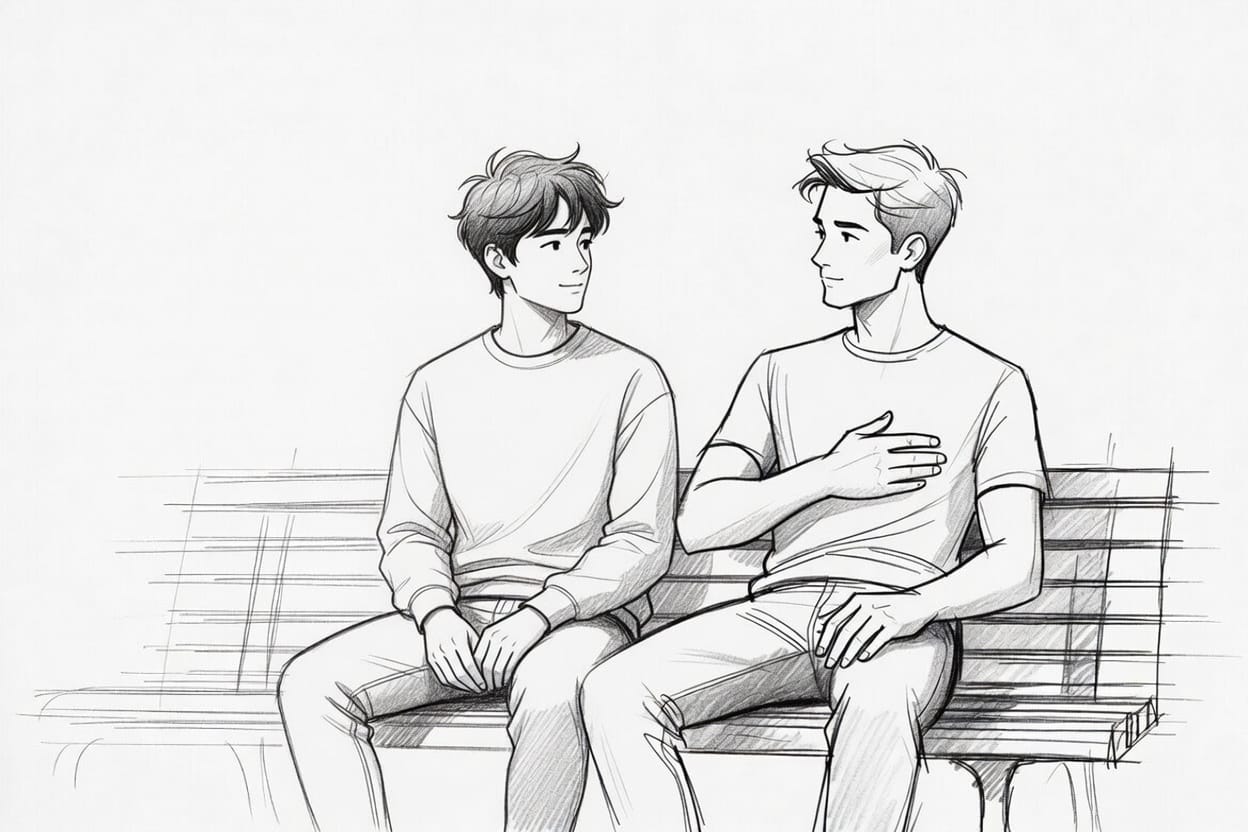
Tell a Friend
Being emotionally vulnerable with same-sex peers is hard for many of us that struggle with our sexuality. Past experiences might have taught us that we weren't safe or accepted. As a result, many of us have learned to build up walls or put on armor so others can't hurt us. And so making friends becomes a challenge.
But when I'm able to confide in a friend my darkest secrets – and have the expectation he will be able to support me – that is where I've found healing. No judgment, just compassion. He doesn't need to say the right things, I just need to know he'll be there for me. And that he accepts me.
When I mentioned relational healing, this is what I mean. That emotional vulnerability is a precursor to deeper/more satisfying relationships. What I'm actually craving. There's an emotional intimacy that I think we require with our same-sex peers. It's innate – nothing to be ashamed of. And when we're starved of that, sometimes those longings morph into something else.
My suggestion would broadly be this: find ways to strengthen your relationships with heterosexual same-sex peers. And perhaps more specifically, find one you can trust and confide in. I know for many of us the prospect of disclosing our struggles feels monumental. If that's you, start small. You don't have to tell everyone everything all at once. Consider this piece I wrote a while back:
 TAOBS
TAOBS
Don't Put Your Eggs in One Basket
While we're on the subject of relationships, there's another point I want to make here – and perhaps it's a word of caution – don't put all your emotional eggs in one basket. When I was younger, I always wanted a brother or a best friend. Someone I could spend all my time with, talk to about everything, lean on completely. On the surface it might sound innocuous. But that kind of intensity can easily slide into emotional dependency, idealization, and – for someone grappling with their sexuality – the very attraction I’m trying to manage.
I've found that tendency in myself at times – still wanting a guy to be there for me. And when that wouldn't happen, I'd get discouraged (further intensifying the same-sex attraction). But as I've got older, I've learned that it's unwise and unrealistic to expect this of another person. No one, male or female, should be expected to meet all my emotional, social, physical and spiritual needs. It takes many people to make us whole. It takes a village.
I've learned that different friends have different strengths. Some are able to support me in more spiritual ways. Other relationships are perhaps not as deep, though we still enjoy time together. I can't get all my needs met with one person. Even if I was happily married to a woman, I think I'd still need time with my male peers to get those same-sex emotional needs met as well.
The notion might be obvious to many. But for a while, it wasn't obvious to me. There was a part of me that wished to find the right guy that could satisfy all my needs. But it doesn't work like that. So when it comes to strengthening relationships, you don't want all your eggs in one basket. It will likely take many people to build you up into the person you want to be.
Avoid Social Media
This last point speaks to managing thoughts. I’m not a fan of social media for many reasons, but chief among these is the way social media is designed to quietly and quickly capture the mind.
I can see a shirtless guy in my feed, linger for half a second, and suddenly the algorithm turns my entire timeline into a parade of exactly what I am trying to avoid. It doesn’t help me focus or manage my thoughts. What you water grows. And there are a lot of weeds on social media. If I'm not careful, I can end up poisoning my mind.
Social media is not real life. I compare my worst moments to others' curated ones. It leaves me feeling discouraged and anxious. So instead of scrolling, I try to prioritize actual relationships. I try to be more selective about what I feed my mind. That includes movies, music, and tv shows too.
You'll have to see what works best for you. I'm merely saying that sometimes it's hard to swim upstream when you’re immersed in a cultural current that pulls you in another direction.
Closing thoughts
Again, I hope these thoughts are helpful. If so, would you let me know? I'm also curious if you can think of anything that's helped you in your journey. I'd love for this place to be a resource for anyone looking for support. Glad you're here.
If these tools are helping, hit subscribe. You’ll get every new post in your inbox, access to the members-only comments, resources and the AI chatbot. No spam, ever.
Member discussion