On Attention and Arousal
When I had AI synthesize the last 10 years of research in sexuality, it identified attention as a driver in sexual response. I'd not heard it talked about in that way before – that what you focus on attentionally can impact your arousal.
I suppose it makes sense. Research shows that attention enables sexual arousal. There are a few studies that find that cognitive distraction significantly reduces physiological arousal (Geer & Fuhr, 1976; Nobre & Pinto-Gouveia, 2008), while mindfulness-based attention training improves sexual desire and functioning (Brotto et al., 2014).
This raises a question: If attention shapes the experience of arousal, could it play a role in how attraction patterns develop? If so, how does that piece fit in the puzzle?
The Attention Hypothesis
Maybe attention is not just a dial that turns arousal up or down, but a compass that influences where arousal gets directed, especially under certain conditions.
I think about my own experience:
- Early attachment wounds created a sense of inadequacy, defectiveness, uncertainty, and lack of confidence at a young age.
- I perceived same-sex peers as whole or complete, as compared to myself. My own inadequacy intensified.
- My attention subconsciously fixated on these comparisons – monitoring, measuring, wondering.
- Over time, that fixation became charged, sexualized.
- The attention consumed by this fixation crowded out space for opposite-sex attraction to develop.
The OCD Connection
I recently wrote about how homosexuality and OCD seem to travel together. Sexual minority individuals showed a 9% OCD rate compared to 1% for heterosexual individuals. In many ways, OCD is an attention system gone haywire – rigid mindset, inability to tolerate ambiguity, constant hypervigilance. These attentional patterns generate obsessive symptoms.
Perhaps that same fixation mechanism also influences how attention gets directed. And how attraction develops downstream.
What I'm Saying
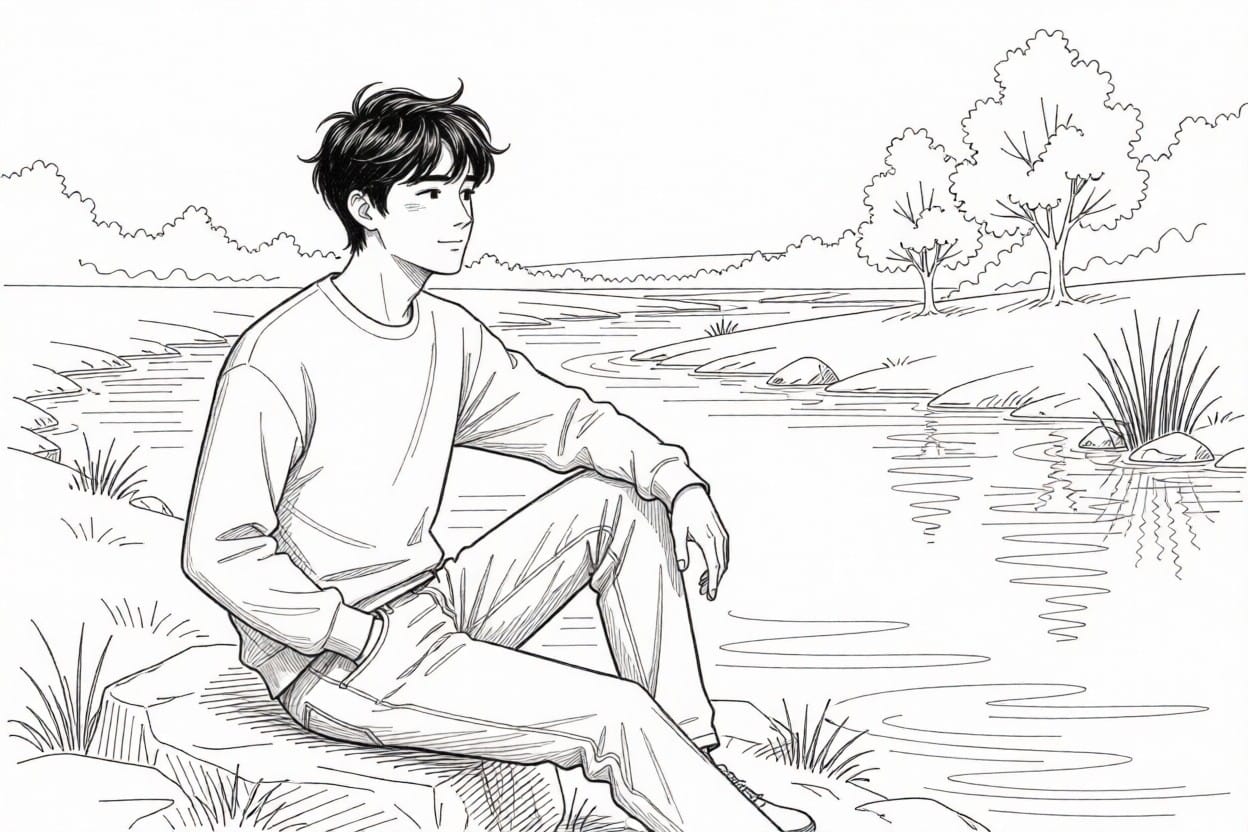
I used to be ashamed of my sexuality. But now I think it's a normal and natural part of being human – like a river flowing. There's nothing wrong with the water.
But I also think there's a default path. We're biologically oriented toward heterosexual orientation. Sometimes, though, that river gets diverted. Trauma and rigidity can construct different paths through sustained attention.
Neural pathways form through repeated attention. Once formed, they don't dissolve so easily. The longer the water erodes, the deeper the channels run.
I also used to think that with enough willpower, I could will myself to become straight. I don't think that's how it works. I believe the system is plastic enough to change, but not through force. The goal isn't to just white knuckle and grit your teeth through it. It's about recognizing what's actually happening and learning from it.
Agency looks like stabilizing the nervous system, gradually retraining attention, and creating an environment for different patterns to emerge. It's not just willpower. It requires that, but more. It's a different kind of work.
And that I'm doing the work doesn't mean I'm broken or defective. It's not a moral failing on my part. It's just me doing the best with the cards I was dealt.
What I'm Not Saying
I sometimes find myself skeptical (or jealous) of people claiming to have changed overnight. As if it were a light switch you could turn on/off. That hasn't been the case for me.
I'm not saying that it's as easy as just learning to shift your attention. If change happens, it happens slow. It's not a 'choice' in the traditional sense, it's more of a sustained determination.
I'm also not saying:
- All same-sex attraction is attentionally constructed (it's obviously more complex)
- Unwanted SSA can be 'cured' (that is the wrong framing)
- People can't find genuine fulfillment in same-sex relationships. Maybe they can.
I'm not claiming certainty. I'm just putting my thoughts out there. The topic is far too nuanced for a single post.
Closing Thoughts
This is a working hypothesis – one that matches my own observations and offers a framework that might be useful.
If sexuality is partly attentionally constructed, attention becomes a leverage point. Maybe not to force change, but to gradually building different patterns.
I think of times when I'm feeling most straight. It's times when I'm productive, confident and engaged in meaningful work. It's when I get outside my own head and focus my attention elsewhere – as opposed to focused on other guys or what I feel I'm missing.
We live in a time where everything is fighting for your attention. And the older I get the more important it is I think to be selective in who gets that attention.
 TAOBS
TAOBS
Brotto, L. A., & Basson, R. (2014). Group mindfulness-based therapy significantly improves sexual desire in women. Behaviour Research and Therapy, 52, 106-112.
Geer, J. H., & Fuhr, R. (1976). Cognitive factors in sexual arousal: The role of distraction. Journal of Consulting and Clinical Psychology, 44(2), 238-243.
Nobre, P. J., & Pinto-Gouveia, J. (2008). Cognitions, emotions, and sexual response: Analysis of the relationship among automatic thoughts, emotional responses, and sexual arousal. Archives of Sexual Behavior, 37(4), 652-661.
Member discussion